April 1945. Prisoners are being murdered at Lüttringhausen penitentiary as the war draws to a close. Joseph Rossaint survives. Nine years of imprisonment lie behind him. Ahead is the question of how to live after resistance – and what it costs to remain true to one’s convictions.
As a young chaplain in Oberhausen, he encounters unemployment and hardship. He organises young people, assists those facing persecution and joins the Peace League of German Catholics. His memoirs describe a priest who also seeks dialogue with socialist and communist youth. Christian responsibility, for him, has to be lived.
When the Centre Party supports the Enabling Act, Rossaint resigns. In Düsseldorf he works across ideological boundaries against Nazi preparations for war. In 1935, he and communist youths produce a leaflet opposing the restoration of conscription. This cooperation will later be used against him.
Arrested in 1936, he becomes the principal defendant in the Berlin Catholic Trial of 1937, a case that attracts international attention. On 28 April the People’s Court sentences him to eleven years in a penitentiary. Nazi justice has turned his work with young people into a case of high treason.
Years in Lüttringhausen bring him close to people whose political convictions differ from his own. Shortly before liberation he escapes the murder of prisoners. The solidarity of imprisonment does not simply belong to the past after 1945: it shapes the bonds he refuses to abandon.
According to SPIEGEL’s account and the VVN’s remembrance, returning would have required withdrawal from political activity and an end to cooperation with communists. Rossaint refuses. He does not return to regular church service. Yet distance from church leadership does not mean abandoning his faith.
Writer, publisher, organiser and co-founder of the VVN association of Nazi victims: Rossaint campaigns against rearmament, nuclear weapons and emergency legislation. He becomes vice-president of the international resistance federation FIR in 1957 and sole president of the VVN in 1971. His contacts cross Cold War borders. His closeness to communist actors belongs in the historical picture alongside his resistance and requires critical context.
He receives the Aachen Peace Prize in 1989 and dies on 16 April 1991. Letters, diaries and memories remain, including in the family archive in Aachen, still awaiting cataloguing. This project aims to connect them with other archival collections and enable further research.
“Inwardly, he consciously remained a priest and lived accordingly.”
Auxiliary Bishop Augustinus Frotz, obituary of 18 April 1991, reproduced by Rheno-Frankonia. Translation from German. ↗History & the present · Editorial reflection
What does peace ask of us today?
War, rearmament and relations between Germany and Russia give Rossaint’s story renewed urgency. His life raises questions: How do we challenge images of the enemy? How do we protect people from violence? How can dialogue and the pursuit of peace remain possible as political camps harden?
Today is not a repetition of the 1930s. Rossaint’s biography offers neither a ready-made answer to current conflicts nor a justification for wars of aggression or authoritarian rule. This archive seeks to make informed discussion possible: about his convictions, their contradictions and our own responsibilities.
02 / Images, film & press
A face. Lasting traces.
Portraits and places of remembrance bring history into view. A television documentary and a later press article offer further perspectives on Joseph Rossaint’s life.
Historical portrait
The person behind the history.
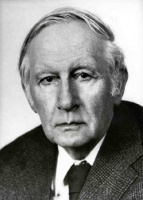
This historical photograph shows Joseph Cornelius Rossaint in later life.
Image source: Konradsblatt / aixpax.de. The source does not name the photographer or date.Published with the family’s permission.
VAS · 2002
The trial in a photograph.
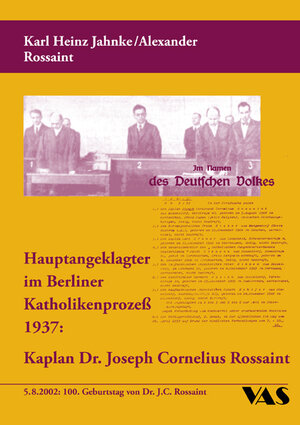
The cover of the 2002 book by Karl Heinz Jahnke and Alexander Rossaint shows a historical courtroom photograph. The book title remains in its original language.
Book image: ISBN.de / VAS. Published with the family’s permission.
Düsseldorf · Marienkirche
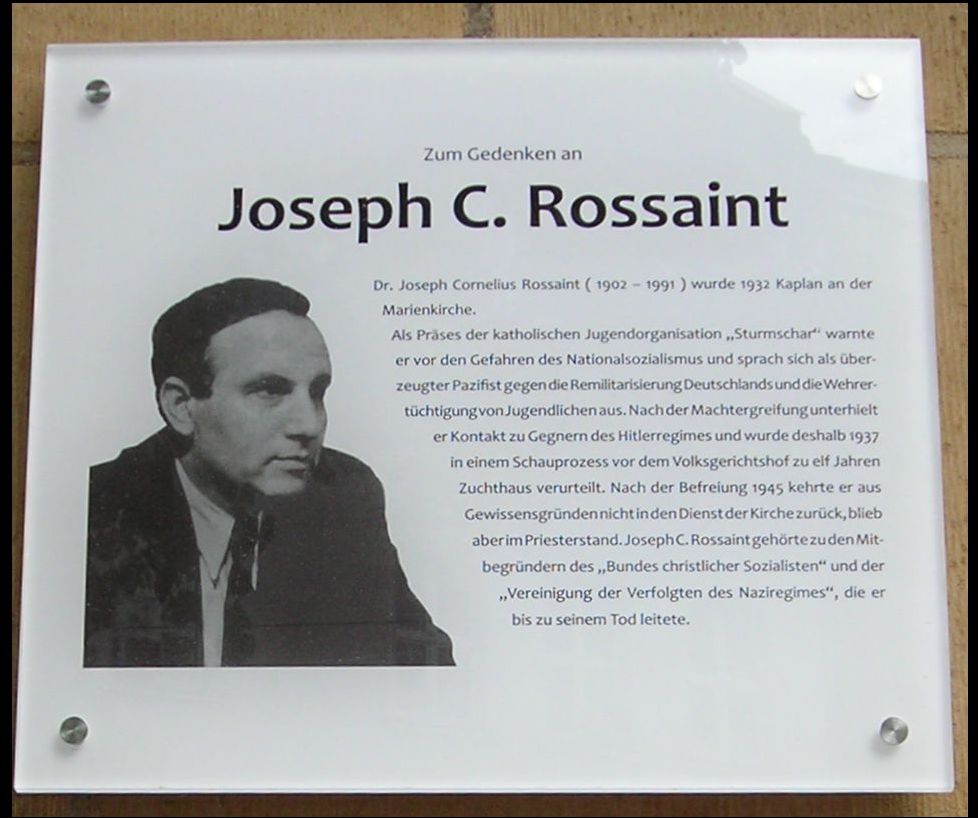
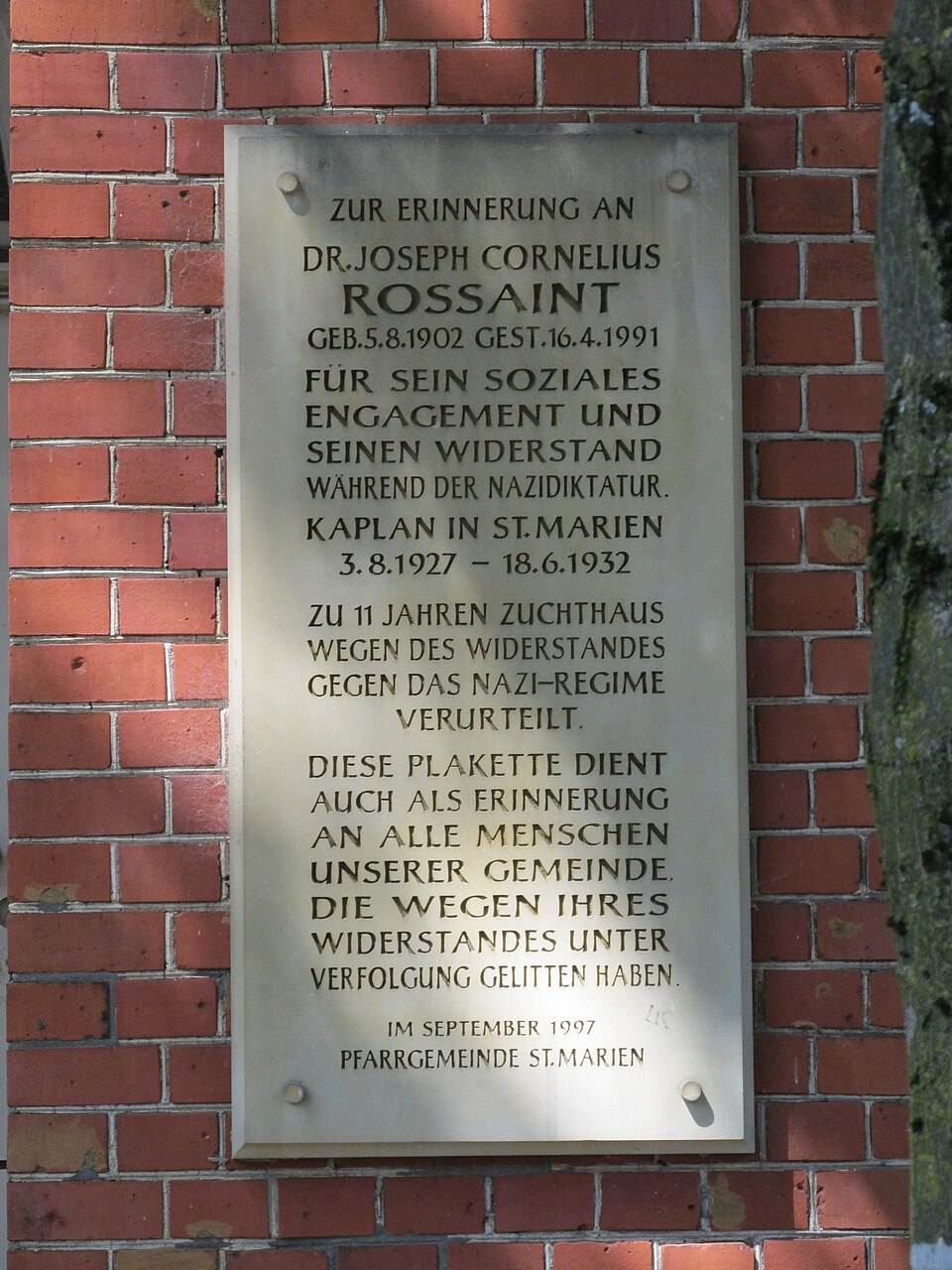
A portrait in public memory.
The plaque recalls Rossaint’s time as a chaplain and his resistance. Photograph taken on 30 April 2010.
A film by Wilfried Viebahn. The Neue Deutsche Biographie records a WDR broadcast on 12 April 1987; the Archdiocese of Cologne’s media library lists a running time of 48 minutes under reference V607.
Archive reference · no online stream yet
A publicly playable version is not yet available here. The linked catalogue documents the film; it does not contain the video.
Images carry source and rights information. Articles and the film remain with their respective providers; no third-party full texts or film copies are hosted here.
03 / Sources & documents
Traces of a life.
Biographies, archives, books and voices. Each entry links to its source. The collection is gradually expanding.
Collection record covering, among other subjects, the League of Christian Socialists and the German Peace Academy. A finding aid, not a complete online collection.
Landesarchiv NRW, Rheinland · DDB · Records 1945–1970
Article on Rossaint’s persecution by the Nazis. Online title: “Wie die Nazis einen aufmüpfigen Kaplan ins Zuchthaus brachten”. The complete article is behind the SPIEGEL+ paywall.
Martin Doerry · SPIEGEL Geschichte 2/2019 · 25 March 2019 · pp. 58–64 · SPIEGEL+
Includes Rossaint’s own memoirs from 1982 and Auxiliary Bishop Augustinus Frotz’s obituary (1991). Personal testimonies with named authors, not a neutral overview.
The online exhibition identifies Rossaint’s trial as a subject of clandestinely distributed camouflaged publications. This establishes their coverage of the trial, not Rossaint’s authorship of every pamphlet shown.
No source found. Try another term or choose “All”.
Curated references · Updated 11 October 2026. A catalogue entry does not mean the work is freely available online. Linked originals generally remain in German.
04 / Books
Preserved in books.
Dr Alexander Rossaint, Joseph’s nephew, published two books about his life and persecution together with historian Karl Heinz Jahnke.
1997
Karl Heinz Jahnke / Alexander Rossaint
Dr. Joseph Cornelius Rossaint Aus seinem Leben und Werk
The volume combines an account of his life with a selection of his writings.
Letters, diaries and personal documents preserve more than dates.
Further papers have survived within the family. This material has not yet been processed. The aim is to examine, describe and, where possible and authorised, make it accessible here.
This project is being developed by Sascha Rossaint, one of Joseph’s great-nephews. It brings scattered sources together and encourages exchange with researchers, archives and anyone interested.
Family papers: cataloguing planned
Remembrance needs participation.
Would you like to help catalogue, translate or digitise material, or support the archive’s work? Please use the contact form.